A/B Testing Web Design: Stop Guessing, Start Converting in 2026


Most web design decisions are educated guesses. Your designer’s instincts, your team’s preferences, your own gut feeling — none of it predicts how real users actually behave. A/B testing web design changes that. It replaces assumptions with data, and opinions with evidence.
Your designer is talented. Your marketing team is experienced. And yet, research consistently shows that roughly 80% of design assumptions prove wrong when tested against real user behavior. That’s not a failure of skill — it’s a fundamental limitation of human intuition. We design for ourselves, not for our users.
A/B testing web design fixes this. It’s the discipline of running controlled experiments on your live site, showing different versions to different visitors, and letting actual behavior determine the winner. No politics. No opinions. Just data.
The business case is straightforward: companies that test consistently report double-digit conversion lifts from single-element changes. A different headline. A reworded button. One fewer form field. These aren’t cosmetic tweaks — they’re revenue decisions. And in 2026, with traffic acquisition costs rising and margins tightening, conversion optimization is one of the highest-ROI investments a business can make.
Here’s what to test, how to test it, and where to start.
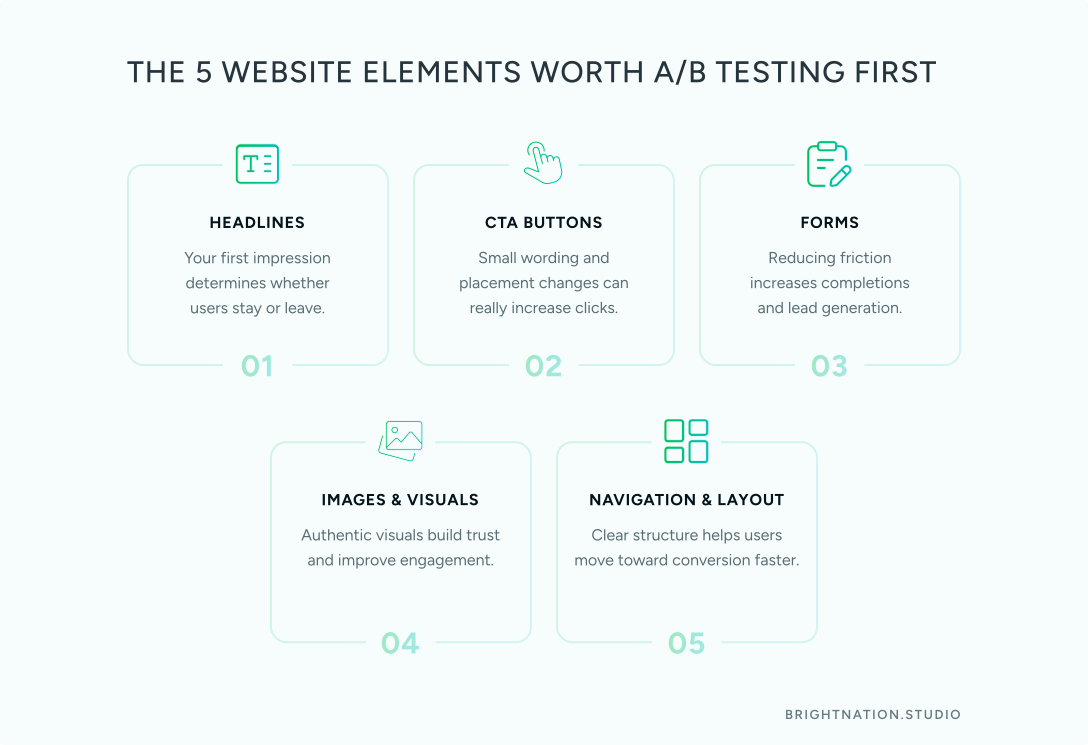
The 5 Elements Worth Testing (Ranked by Impact)
1. Headlines
Your headline is the first thing every visitor reads. It determines, within seconds, whether they stay or leave. Nothing on your page has more leverage.
What to test: the tone (formal vs. conversational), the value proposition (benefits vs. features), and the length (punchy vs. detailed). A feature-focused headline like “Advanced Reporting Dashboard with 40+ Metrics” tells users what the product does. A benefit-focused version like “Know Exactly Where Your Revenue Is Coming From” tells them what it does for them. That shift alone has doubled engagement rates in documented case studies.
Optimized headlines consistently produce conversion lifts of 10–30%. That’s not a rounding error. That’s the difference between a campaign that breaks even and one that scales.
The psychology: Users don’t read pages — they scan them. Your headline is the gateway. If it doesn’t immediately connect to what the visitor wants, they’re gone.
2. CTA Buttons
Four variables drive CTA performance: copy, color, placement, and contrast.
Copy is the most underestimated. “Learn More” is passive. “Get Started” is active. Action-oriented CTAs consistently outperform soft-sell alternatives by 15–25% in click-through rates. The psychology is simple: specific, directive language removes the mental friction of deciding what happens next.
Color and contrast matter because visibility drives clicks. Placement matters because a CTA buried below the fold won’t convert visitors who don’t scroll. Test a sticky CTA against a static one — the results often surprise teams that assumed users would scroll.
3. Forms
Forms are where conversions die quietly. Every additional field you add costs you completions. Research from various CRO studies puts the average conversion drop at 4–8% per additional form field. That’s not theoretical — it compounds fast.
A brand that reduced their contact form from 8 fields to 4 saw form completions increase by over 50%. They didn’t change the design, the copy, or the page layout. They just asked for less.
Test field count, layout (single-column vs. multi-step), and placement (on-page vs. dedicated landing page). Multi-step forms often outperform single-page forms for longer processes because they trigger what psychologists call the completion effect: once someone starts, they’re more likely to finish.
The psychology: Completion anxiety is real. A short form feels achievable. A long one feels like work.
4. Images and Visuals
Humans process visuals roughly 60,000 times faster than text. The image above your fold is communicating before your headline finishes loading in the visitor’s mind.
Test stock photography against custom photography. Test people against product-only imagery. Test static images against subtle animation. Authentic images — real team members, real customers, real environments — consistently outperform generic stock photos on engagement metrics. In some studies, pages with authentic photography see 30–40% higher time-on-page.
The wrong image doesn’t just fail to help. It actively undermines the message your copy is trying to deliver.
5. Navigation and Layout
Menu labels, content block order, and social proof placement all affect how users move through your site. These elements feel structural, but they’re highly testable.
One frequently documented result: moving testimonials above the fold — rather than burying them at the bottom of the page — significantly increases trust signals at the moment of first impression. Users who see social proof early convert at higher rates than those who encounter it after they’ve already decided to leave.
Test your menu labels for clarity. Test whether collapsing secondary navigation items reduces distraction. Test whether reordering your content blocks changes scroll depth.
Stop designing by gut feeling. Start letting your users tell you what works.
How to Run Tests That Actually Work
Bad testing is worse than no testing. It produces false confidence and sends teams in the wrong direction. Here’s how to do it right.
Isolate one variable at a time. Test your headline OR your button color, not both. If you change two things and conversions improve, you have no idea which change caused it. Single-variable testing is the only way to build reliable knowledge.
Wait for statistical significance. Do not stop a test after 50 visitors, or even 500. Most tests need a minimum of 1,000 visitors per variant — ideally more — to reach 95% statistical confidence. Stopping early is the most common testing mistake, and it produces results that don’t hold up when you implement the winner.
Define your success metric before you start. Are you measuring clicks? Form completions? Time on page? Revenue per visitor? Pick one primary metric and stick to it. Teams that measure everything end up learning nothing.
Document wins and losses equally. A failed test is not wasted time — it’s data. A test that shows your hypothesis was wrong narrows the solution space and prevents you from making the same mistake again. Keep a testing log.
Don’t ignore mobile vs. desktop. A CTA that performs brilliantly on desktop may underperform on mobile because of placement or size. Segment your results by device. What works for one audience may not work for the other.
The Testing Priority Framework
Not sure where to start? Diagnose your problem first, then match it to the right test.
High traffic, low conversions: Your messaging isn’t landing. Start with headlines and CTAs. These have the highest impact on whether a visitor decides to act.
Traffic drops off quickly: Users aren’t finding what they expected. Test page speed, above-fold content, and your opening value proposition.
Form abandonment: You’re losing people at the final step. Test form length first — reduce fields aggressively. Then test layout and placement.
Low engagement across the board: Your content structure or visuals aren’t holding attention. Test image authenticity, content block order, and navigation clarity.
Tools to Use
Google Optimize — Free, integrates with Google Analytics, solid for getting started
Optimizely — Enterprise-grade testing with advanced targeting and statistical rigor
VWO (Visual Website Optimizer) — Strong mid-market option with a visual editor
Hotjar / Crazy Egg — Heatmaps and session recordings that show you what to test before you start testing
On timeline: most tests need 2–4 weeks to reach statistical significance, assuming reasonable traffic volume. Don’t rush it. Implement winners immediately after significance is confirmed, then move to the next test.
Small Changes, Big Results
A/B testing isn’t about rebuilding your website. It’s about finding the specific friction points that are quietly costing you conversions every single day.
One headline change. One button rewrite. One fewer form field. These are the moves that deliver 20%, 30%, even 50% conversion improvements — without a redesign, without a new brand strategy, without a six-month agency engagement.
At Bright Nation Studio, we build testing-ready websites and run data-driven optimization programs that turn traffic into revenue. If you’re ready to replace assumptions with results, let’s talk.