Privacy-First Marketing and Website Security as Competitive Advantages in 2026


Most business owners assume their website is fine because it looks fine. That assumption is one of the most expensive mistakes in digital business today.
In 2026, the threats to your brand come from two directions: privacy violations that erode customer trust, and security breaches that can quietly compromise your site for months before anyone notices.
Your website looked fine this morning. Pages loaded. Forms worked. Nothing seemed off. But “looking fine” and “being protected” are two very different things.
According to IBM’s 2024 Cost of a Data Breach Report, the average time to identify a breach is 194 days. That’s six months of operating normally while customer data is being harvested, SEO spam is being injected, and your reputation is quietly eroding. By the time you find out, the damage is already done. Google may have already flagged your site. Customers may have already seen warnings. Your ad accounts may already be at risk.
This is the dual crisis facing businesses in 2026. Privacy violations destroy trust on one side. Security breaches destroy everything on the other. And the businesses that treat both as compliance checkboxes rather than strategic priorities are the ones most exposed.
The good news: you can control this. The businesses winning in 2026 aren’t just the ones with the best products. They’re the ones customers trust most.
The Privacy-First Marketing Shift Is Already Here
Third-party cookies are gone. Google’s Privacy Sandbox has reshaped how behavioral tracking works across Chrome, and Apple’s App Tracking Transparency has made cross-app tracking opt-in by default. The era of collecting everything and sorting it out later is over.
A 2024 Cisco Consumer Privacy Survey found that 80% of consumers say data privacy is important when choosing which companies to interact with, and nearly half have switched providers due to privacy concerns. That number has grown consistently year over year. Your customers are paying attention even when you’re not.
The forward-thinking shift is toward zero-party data: information customers intentionally give you because they see the value in doing so. Think quiz results, preference centers, product recommendations based on self-reported answers, loyalty programs with clear value exchanges. This approach builds a marketing foundation that doesn’t depend on third-party platforms, doesn’t violate trust, and actually produces better conversion data because the intent is explicit.
Apple built its “privacy as a feature” positioning into one of the most recognized brand advantages in tech. Patagonia built customer loyalty partly through radical transparency about its supply chain and data practices. These aren’t coincidences. They’re strategic decisions that compounded into trust, and trust compounded into growth.
Privacy-first marketing isn’t a limitation. It’s a competitive signal that says: we respect you, and we’re worth choosing.
The Invisible Security Crisis Businesses Don’t See Coming
Here’s the fear most business owners carry quietly: what if we’re already compromised and just don’t know it?
It’s a legitimate fear. Attackers don’t always announce themselves. Many breaches begin with a single vulnerability, a weak password, an outdated plugin, a misconfigured permission, and then sit dormant while the attacker maps your systems, harvests data, or plants malware designed to activate later.
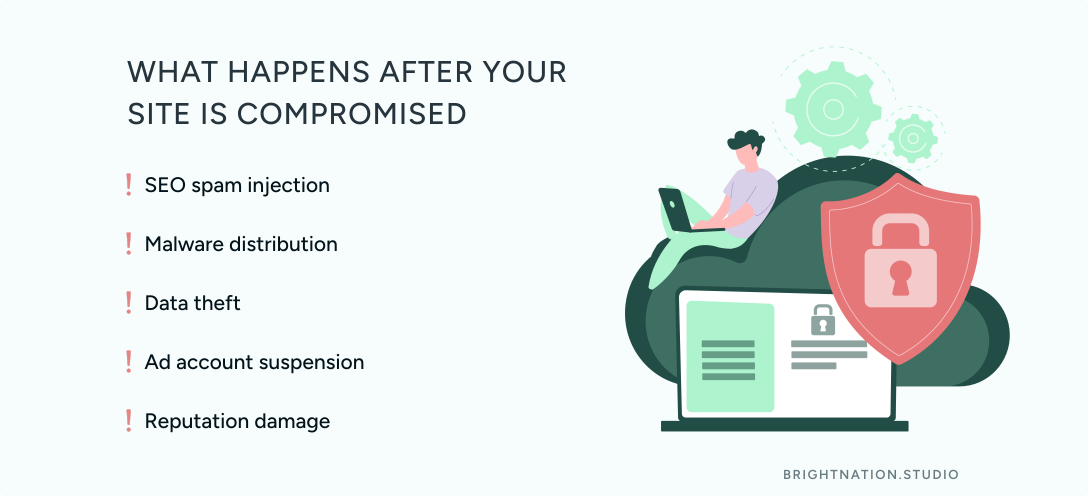
When a site is compromised, the cascade effect is severe:
SEO spam injection: Hidden links to malicious sites appear in your page code, tanking your search rankings and triggering Google Search Console warnings.
Malware distribution: Your site becomes a vehicle for infecting visitors, prompting browser security warnings that kill traffic overnight.
Data theft: Customer names, emails, payment details, and behavioral data are extracted and sold.
Ad account suspension: Google Ads and Meta Ads both suspend accounts associated with compromised or flagged domains.
Reputation damage: Once customers see a “This site may be harmful” warning in Chrome, the trust recovery timeline is measured in months, not days.
One mid-sized e-commerce business discovered in 2024 that a plugin vulnerability had been exploited for nearly five months. During that time, their checkout page had been skimming credit card data. They found out not from their monitoring tools (they didn’t have any) but from a customer complaint and a subsequent chargeback spike. The recovery cost, including forensics, legal notification requirements, and lost revenue during remediation, exceeded $180,000.
The site had looked fine the whole time.
The Real Cost of “Looking Fine”
Technical debt is invisible until it isn’t. Sites launched without security fundamentals, running outdated CMS versions, or built on a stack of unvetted third-party plugins can appear completely normal to the naked eye while carrying serious vulnerabilities underneath.
The plugin problem is especially acute for WordPress-based businesses. The WordPress ecosystem powers over 40% of the web, which makes it the most targeted platform by volume. A single abandoned plugin with an unpatched vulnerability is an open door. Many site owners have 20, 30, or even 50 plugins installed, some actively maintained, some not. Most owners have no protocol for vetting or updating them without risking breaking something else.
Then there’s the human error factor. A team member clicking a phishing link, using a shared password, or granting admin access to the wrong vendor account can expose your entire operation in seconds. According to Verizon’s 2024 Data Breach Investigations Report, 68% of breaches involve a human element. This isn’t a technology problem alone. It’s a culture problem.
Downtime compounds the damage. Gartner research puts the average cost of IT downtime at $5,600 per minute for enterprise organizations. For SMBs, the proportional impact is just as severe when you factor in lost sales, customer service strain, and emergency recovery costs.
Security doesn’t have to be a panic expense. When it’s built proactively, it’s a manageable, predictable investment. When it’s reactive, it’s a crisis.
The Security Basics That Prevent Panic
Here’s what genuinely protected looks like:
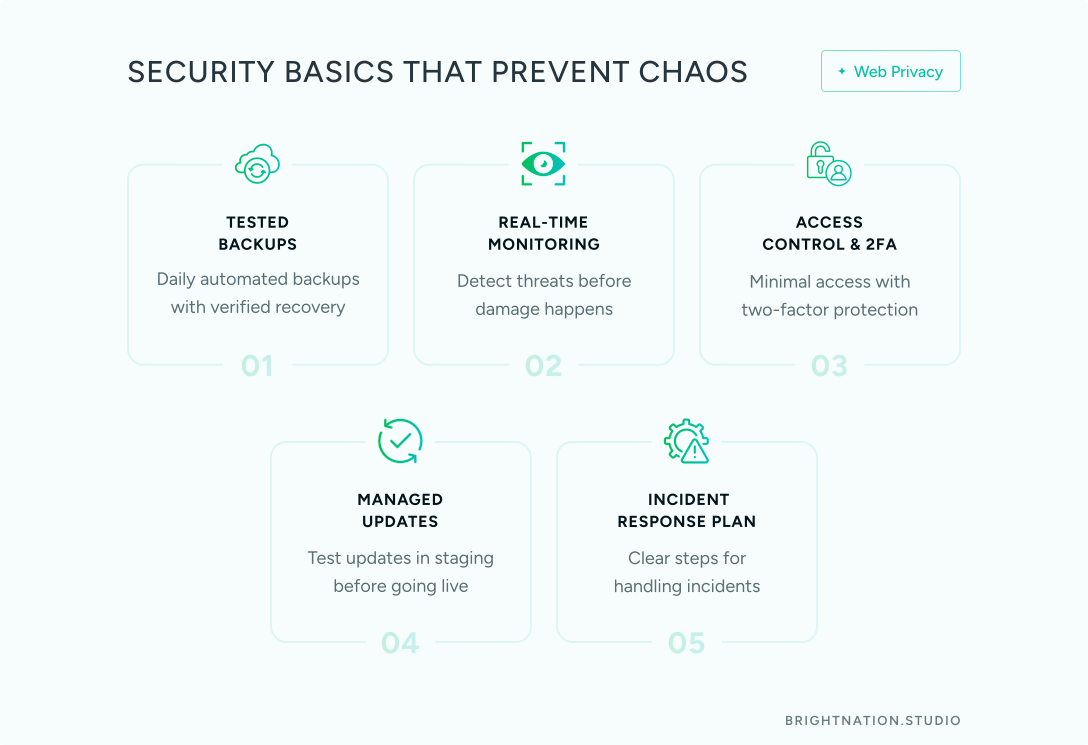
Backups that are actually tested. Most businesses believe they have backups. Fewer have tested whether those backups restore correctly. Automated daily backups stored off-site (not just on your hosting server) with a documented recovery process are the baseline. The question isn’t “do we have backups?” It’s “how fast can we be fully operational after an incident?”.
Real-time monitoring. You should not be finding out about suspicious activity from a customer email or a Google Search Console alert. Tools like Sucuri, Wordfence (for WordPress), or Cloudflare’s security suite provide real-time alerts for malware, unauthorized logins, and traffic anomalies. Monitoring means you find the problem, not the other way around.

Let’s get started! Contact us today to discover how we can help.
Access control and two-factor authentication. Every team member and vendor with access to your site, hosting, or admin accounts should be operating under the principle of least privilege: they get access to exactly what they need and nothing more.
Two-factor authentication (2FA) on all accounts eliminates the most common attack vector. One compromised password should not be enough to bring down your business.
A managed update protocol. Updates need to happen, but they need to be tested before they’re deployed to your live site. A staging environment lets you apply plugin and CMS updates, verify nothing breaks, and then push to production. This removes the choice between “stay vulnerable” and “risk breaking the site.”
An incident response plan. If something goes wrong today, who gets called first? What steps are taken in what order? Who has the authority to take the site offline if needed? This plan should exist in writing, be tested at least annually, and be known by more than one person on your team.
Privacy and Security as Customer-Facing Trust Signals
Customers make trust decisions in seconds. When they land on your site, they’re scanning for signals before they read a single word of copy.
An SSL certificate and HTTPS in the URL bar are the baseline expectation. A missing padlock icon will cause a measurable percentage of visitors to leave immediately.
Beyond that, trust badges, clearly written privacy policies (not legal boilerplate), and transparent cookie consent flows all communicate that you take this seriously.
Contact forms and checkout pages deserve special attention. A form that collects name, email, phone, and business details is a data asset and a liability. That data needs to be encrypted in transit, stored securely, and handled according to a documented policy. Customers who fill out your form are trusting you with their information. That trust should be earned and protected.
Transparent data handling, stating plainly what you collect, why you collect it, and how it’s protected, is increasingly a differentiator. Most businesses bury this in legal language. The ones that communicate it clearly are the ones customers remember as trustworthy.
Protection isn’t a feature you add.
It’s a culture you build.
Building a Protection-First Culture
That means regular team training on phishing recognition, password hygiene, and access protocols. It means vetting every third-party tool before it touches your site or your customer data. It means scheduling quarterly security audits rather than waiting for something to break.
Vendor vetting is particularly underrated. Every marketing tool, analytics platform, or CRM integration you connect to your site introduces a new potential vulnerability.
Before adding any tool, the question should be: what data does this access, where does it store it, and what’s their security track record?
Regular audits, whether internal or conducted by a security partner, find fragility before it becomes a crisis. A vulnerability scan today costs a fraction of what a breach response costs six months from now.
Are You Actually Protected? A Practical Checklist
Use this as your baseline assessment:
- Tested, automated backups with a verified restoration process and documented recovery timeline
- Real-time security monitoring with alerts sent to a responsible team member (not just a log no one reads)
- SSL certificate and HTTPS active across every page of your site
- Two-factor authentication enabled for all team and vendor accounts
- Regular security audits and vulnerability scans scheduled on the calendar, not done reactively
- A clear, plain-language privacy policy that explains what you collect and why
- Data minimization practices: only collecting what you genuinely need
- Incident response plan documented, tested, and known by at least two people
- Plugin and tool update protocol that uses a staging environment before live deployment
- Customer data access controls and encryption at rest and in transit
If you’re unsure about any item on this list, that uncertainty is the answer.
How Apple Turned Privacy Into a Growth Engine
Apple’s privacy-first positioning is the clearest large-scale example of this strategy working at scale. When they introduced App Tracking Transparency in 2021, requiring apps to explicitly ask users for permission to track them, the opt-in rate settled around 25%. Apple framed this not as a technical change but as a statement of values.
The result: customers who already trusted Apple trusted them more. The brand differentiation became a retention driver. And the message, “we’re on your side when it comes to your data,” became a genuine competitive advantage against competitors who couldn’t credibly make the same claim.
You don’t need Apple’s scale to apply this principle. A small professional services firm that communicates clearly about its data practices, uses consent-based marketing, and visibly protects customer information is making the same statement to its audience: we can be trusted. In a market where most competitors treat privacy as an afterthought, that’s a meaningful differentiator.
Protection Is a Growth Strategy
The businesses that will win in 2026 and beyond aren’t necessarily the ones with the biggest budgets or the most sophisticated tech stacks. They’re the ones their customers trust most.
Security and privacy aren’t costs to minimize. They’re investments in every customer relationship you’ve built and every one you’re trying to build. A breach doesn’t just cost money to fix. It costs the trust you’ve spent years earning.
The goal is to reach a point where you’re not asking “what if something goes wrong?” but instead saying “we know exactly what happens if something goes wrong, and we’re ready.”
That peace of mind is available to you. It requires intention, the right systems, and a partner who understands that your website isn’t just a digital presence. It’s the foundation your business runs on.
At Bright Nation Studio, we build digital experiences designed to perform, protect, and grow with your business. If you’re not certain your current foundation can answer yes to every item on that checklist, let’s talk. A security and privacy audit is the most valuable conversation you can have before something forces it.