Your Slow Mobile Site Is Costing You More Than You Think


Over 60% of web traffic is now mobile, and every second of load delay drives users away, with 88% never returning after a bad experience. If you’re running paid ads, a slow mobile site means you’re paying for clicks and losing them instantly.
Most business owners know their mobile site isn’t great
The frustration is real: you paid for a new website, you’re running ads, you’re doing everything right on paper. But the leads aren’t coming in the way they should. The calls aren’t converting. And somewhere between the click and the contact form, people are disappearing.
The problem isn’t your product. It’s your mobile performance. And in 2026, mobile-first website performance isn’t a nice-to-have. It’s the difference between a site that grows your business and one that quietly drains it.
The Silent Revenue Leak
Over 60% of global web traffic now comes from mobile devices. If your site loads slowly, looks cramped, or makes users pinch and scroll just to read a paragraph, you’re losing customers before they ever see what you offer.
Here’s the part that stings: every second of delay matters. Research from Google shows that bounce rates increase by roughly 32% when page load time goes from 1 second to 3 seconds. Push that to 5 seconds and you’re looking at a 90% spike in users walking away. And 88% of users say they won’t return to a site after a bad experience.
Not a second chance. Gone.
Now layer the ad spend problem on top of that. If you’re running paid search or social campaigns, you’re paying per click. Every visitor who lands on a sluggish, frustrating mobile experience is a wasted dollar. You’re not losing money because your ads are bad. You’re losing it because the destination is broken.
Google’s Core Web Vitals make this even more consequential. Slow sites rank lower in organic search, pay higher effective costs in paid campaigns, and convert less traffic into revenue. A slow site doesn’t just frustrate users. It compounds every marketing cost you have.
Why “We Have a Website” Isn’t Enough Anymore
Having a website used to be the baseline. It no longer is. The real question is whether your mobile experience is actually working for your business.
For most companies, there’s a significant gap between how a site looks on a desktop in a design review and how it performs on a phone in the real world. A site that looks polished on a 27-inch monitor can feel broken on a 6-inch screen with a 4G connection.
The signals are easy to spot if you know where to look:
High bounce rate on mobile traffic — visitors are leaving almost immediately
Low time-on-site from mobile users — they’re not engaging, they’re escaping
Near-zero contact form completions on mobile — users give up before they reach the CTA
Paid ad performance below industry benchmarks — the traffic is there, the conversions aren’t
The trap many businesses fall into is the visual redesign. A new look, a refreshed brand, a modern layout. It feels like progress. But a redesign without performance optimization is a cosmetic fix on a structural problem. Research from HTTP Archive suggests that a significant share of newly launched websites still fail Core Web Vitals benchmarks at launch. The design changed. The underlying performance didn’t.
If your customers are busy — and they are — your site needs to work fast.
Full stop.
What Fast Actually Feels Like (and How to Get There)
Speed isn’t just a technical metric. It’s a feeling. A fast site feels confident, trustworthy, and easy. A slow one feels uncertain. Users don’t consciously think “this site has a poor Largest Contentful Paint score.” They just feel friction and leave.
The LCP benchmark (Largest Contentful Paint, the time it takes for the main content to load) should be under 2.5 seconds. That’s Google’s threshold for a “good” experience. Most business websites don’t hit it on mobile.
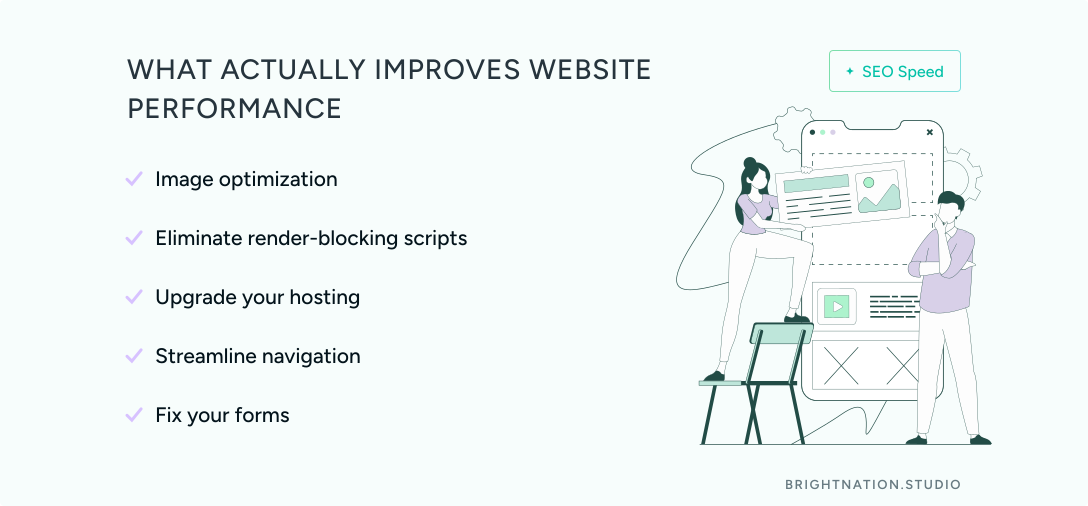
The fixes that move the needle:
Image optimization: Convert images to WebP format and implement lazy loading so images below the fold don’t slow the initial load
Eliminate render-blocking scripts: Third-party scripts, tag managers, and chat widgets can delay page rendering significantly
Upgrade your hosting: Cheap shared hosting is often the hidden culprit. Server response time directly impacts every performance metric
Streamline navigation: It shouldn’t take effort to find where to click. Mobile menus should be thumb-friendly and immediately obvious
Fix your forms: A contact form designed for a mouse doesn’t work for a thumb. Fields need to be large enough to tap, keyboards should auto-trigger the right type (numeric for phone numbers), and the submit button needs to be impossible to miss
The results are real. One B2B services company reduced their mobile load time from 6.2 seconds to 2.8 seconds through image optimization and hosting upgrades alone. Their mobile contact form completion rate increased by 43% within 60 days. No new ad spend. No redesign. Just a site that actually worked.
One more thing worth knowing: Google now uses mobile-first indexing for all sites. Your mobile experience isn’t a secondary version of your website. It IS your website, as far as search rankings are concerned.
The One Chance Rule
53% of mobile users abandon a page that takes more than 3 seconds to load. Your customers are not sitting at a desk with time to spare. They’re between meetings, on the train, waiting for a coffee. They have a problem, they searched for a solution, and they landed on your site. You have one window to earn their attention.
If the experience is bad, they won’t give you a second chance. They’ll go to the next result.
The competitive opportunity here is significant. Most of your competitors have the same problem. Their mobile sites are slow, their forms are frustrating, their navigation was designed for desktop. Fixing your mobile performance doesn’t just stop the bleeding. It puts you ahead of the businesses who haven’t figured this out yet.
Smooth and easy in practice means: loads fast, navigation is obvious, content is readable without zooming, forms work on a phone keyboard, and the path to contact takes two taps at most. That’s the standard. It’s achievable. And most businesses aren’t meeting it.
Audit Your Mobile Experience: 5 Questions to Ask Right Now
Does your site load in under 3 seconds on a 4G connection?
Can users find your contact form or primary CTA in under 2 taps?
Are your images optimized for mobile without visible quality loss?
Do your forms work easily on a phone keyboard?
Have you checked your Core Web Vitals score in Google Search Console recently?
If any of these answers is “no” or “I’m not sure,” your mobile site is costing you business today.
At Bright Nation, we don’t just build sites that look good. We build sites that perform. If you’re ready to stop losing traffic you’ve already paid for, let’s talk about what mobile-first performance optimization looks like for your business.