Hustle Culture Is Burning Out an Entire Generation of Creatives


Burnout rates in creative industries are among the highest of any sector, with the WHO formally recognizing burnout as an occupational syndrome. Add the pressure of AI-driven expectation creep, the comparison trap of curated social media highlight reels, and the impossible demand for speed and perfection simultaneously, and the result is a generation of exhausted professionals who can’t remember why they loved their work.
The Badge That’s Actually a Warning Sign
Being busy has become the creative industry’s most coveted credential. Designers wear exhaustion like a badge. Copywriters casually mention they haven’t taken a real day off in months. Creative directors describe their 60-hour weeks with a kind of quiet pride, as if the suffering itself is proof they’re serious about their craft.
What nobody says out loud is that most of them are running on empty.
The World Health Organization officially recognized burnout as an occupational syndrome in 2019, defining it by three markers: exhaustion, growing mental distance from one’s work, and reduced professional efficacy. Creative industries check all three boxes at alarming rates. Studies suggest that professionals in design, advertising, and media experience burnout at rates significantly higher than the general workforce, with some surveys placing the figure above 70% among agency workers.
The cruelest part of hustle culture burnout in creatives isn’t the exhaustion. It’s the timing. Designers get the promotion they worked years for and feel nothing. Copywriters land the dream client and can’t access the excitement. The achievement arrives, but the person who wanted it is already gone.
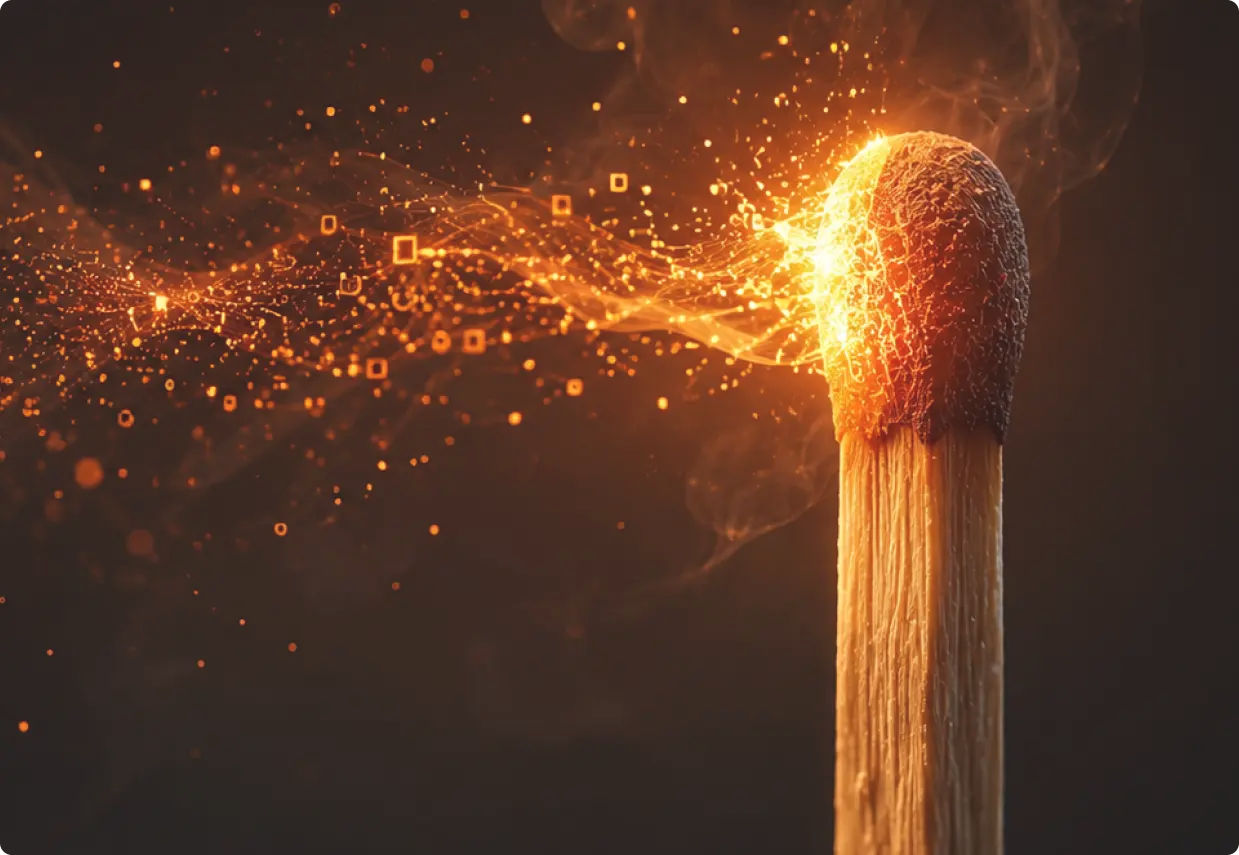
Everyone knows the flame burns. Nobody stops flying toward it.
And now there’s a new accelerant. AI tools were supposed to absorb the tedious parts of creative work, freeing up time for the thinking that actually matters. Instead, productivity expectations simply rose to match the new output speed. The workload didn’t shrink. The bar just moved higher.

The Three Traps Nobody Warns You About
The Burnout Spiral
It starts gradually. Work bleeds into evenings because there’s always one more revision. Weekends become catch-up sessions. Holidays get colonized by Slack notifications that feel too urgent to ignore.
The erosion is quiet. There’s rarely a single moment where a creative professional decides to stop loving their work. It just happens over time, the way water carves through stone. One Tuesday, they sit down to start a new project and realize the spark they used to feel isn’t there anymore.
The physical reality follows: persistent exhaustion that sleep doesn’t fix, an inability to concentrate, a creative paralysis where the blank canvas stops feeling like possibility and starts feeling like accusation.
Achievements keep accumulating. The portfolio grows. The client list expands. But the wins feel hollow because there’s no energy left to actually feel them. Research consistently shows that prolonged burnout degrades output quality, decision-making, and creative problem-solving, the very things creative professionals are paid to do.
The Comparison Assembly Line
LinkedIn and Behance have become performance theaters. Every portfolio looks like a masterpiece. Every career announcement reads like a victory lap. Nobody posts the 11pm panic edits, the projects that went sideways, the clients who made them question everything, or the weeks they couldn’t produce anything worth showing.
Imposter syndrome moves into this gap. It whispers that everyone else has figured something out that you haven’t. That the confidence in other people’s posts reflects their actual daily experience. That you’re the only one struggling.
The truth is that creative professionals are comparing their unfiltered daily reality against a curated highlight reel. Research on social media and professional mental health consistently finds that passive scrolling through peers’ achievements correlates with increased anxiety, decreased self-worth, and heightened feelings of inadequacy. The comparison isn’t just unfair. It’s structurally designed to make everyone feel like they’re falling behind.
The Perfectionism Prison
Hustle culture makes an impossible demand: produce faster AND produce better, simultaneously, without compromise.
The cycle this creates is predictable and brutal. The work doesn’t feel good enough, so the creative professional works harder. The harder work still doesn’t satisfy the internal standard, which has risen in response to the effort. Deeper exhaustion follows. The standard rises again.
Perfectionism doesn’t produce better work. It produces paralysis and self-doubt dressed up as high standards. The real pattern plays out across agencies and studios every day: a designer rebuilds the same layout four times, missing the deadline, still convinced it isn’t right. A copywriter rewrites the opening line of a brief until the brief is late and the confidence is gone.
Speed and perfection cannot coexist under pressure. Hustle culture demands both anyway.
The New Pressure: AI Made It Worse, Not Better
The promise was straightforward. AI handles the grunt work, the repetitive tasks, the first drafts, the asset resizing, the research compilation. Creative professionals get their time back. They use it for the high-value thinking that machines can’t replicate.
That’s not what happened.
What happened instead is expectation creep. If an AI tool can generate a workable draft in ten minutes, the question that follows in agencies and client meetings is: why aren’t you producing more? The efficiency gain didn’t translate into breathing room. It translated into a higher baseline for output volume.
Creative professionals now compete against each other and against machine output speed simultaneously. The psychological toll is specific and corrosive: feeling replaceable while being expected to do more than ever before. A 2023 survey by Adobe found that 79% of creative professionals reported feeling pressure to produce more content than ever, with AI adoption cited as a key driver of rising expectations rather than reduced workload.
Even downtime has been colonized. Rest, for many creative professionals, means scrolling LinkedIn instead of working, building mental to-do lists instead of actually switching off, consuming content about productivity instead of recovering from the cost of constant production. The nervous system stays activated. The creative reserves never actually refill.

What It Actually Takes to Recover
Recovery from creative burnout isn’t a weekend away or a productivity hack. It’s a structural shift in how success gets defined and defended.
Redefine success around impact, not volume. The question worth sitting with is whether the work being produced is work worth being proud of, or whether it’s just output for output’s sake. Chasing LinkedIn reactions and chasing meaningful work are not the same pursuit. Treating them as identical is how creative professionals end up prolific and hollow at the same time.
Set real boundaries and hold them under pressure. Specific work hours aren’t a sign of limited ambition. They’re how creativity survives long enough to be worth something. The guilt that comes with logging off on time is real, and it passes. Rest isn’t a reward given after enough productivity. It’s maintenance, the same way sleep is maintenance. Treating it as optional produces the same result as skipping sleep: eventual system failure.
Say no with intention. Every project accepted beyond genuine capacity is creative quality being traded away quietly. The professionals who produce the most respected work are rarely the ones who say yes to everything. They’re the ones who know what they’re protecting when they decline. Saying no is a complete sentence for someone who understands their own value.
Stop and acknowledge what’s finished. Creative professionals have a particular habit of completing something significant and immediately pivoting to what’s next without pausing. Stopping to register what’s been accomplished isn’t indulgent. It’s psychological fuel. The brain needs to close loops, to register progress, to feel the satisfaction of completion before it can generate the energy to begin again.
Build community instead of competing in isolation. The creative industry runs on a shared silence about how hard things actually are. Everyone performs confidence online while struggling privately. Sharing what’s genuinely difficult, with peers, with collaborators, in honest conversations, breaks the cycle for everyone involved. Collaboration produces better work than quiet competition. It also produces professionals who last.
Meaningful work requires more than time. It requires space — to think slowly, experiment freely, and fail without fear.
The Smartest Creatives Rest
The professionals producing the most meaningful work aren’t the ones working the most hours. They’re the ones who’ve figured out that creativity requires space: space to think slowly, to experiment without pressure, to fail without catastrophe.
Sustainable ambition beats burnout every single time. Not because it’s the comfortable choice, but because burned-out creatives stop producing anything worth remembering. The work suffers. The people suffer. And the industry loses exactly the kind of original thinking it claims to value.
The only question is how long it takes to figure that out.